Tokenized Treasuries 2026: BlackRock BUIDL & RWA Yield Guide
Tokenized Treasuries 2026: BlackRock BUIDL & RWA Yield Guide

Tokenized Treasuries 2026: BlackRock BUIDL & RWA Yield Guide
Tokenized Treasuries 2026: BlackRock BUIDL & RWA Yield Guide
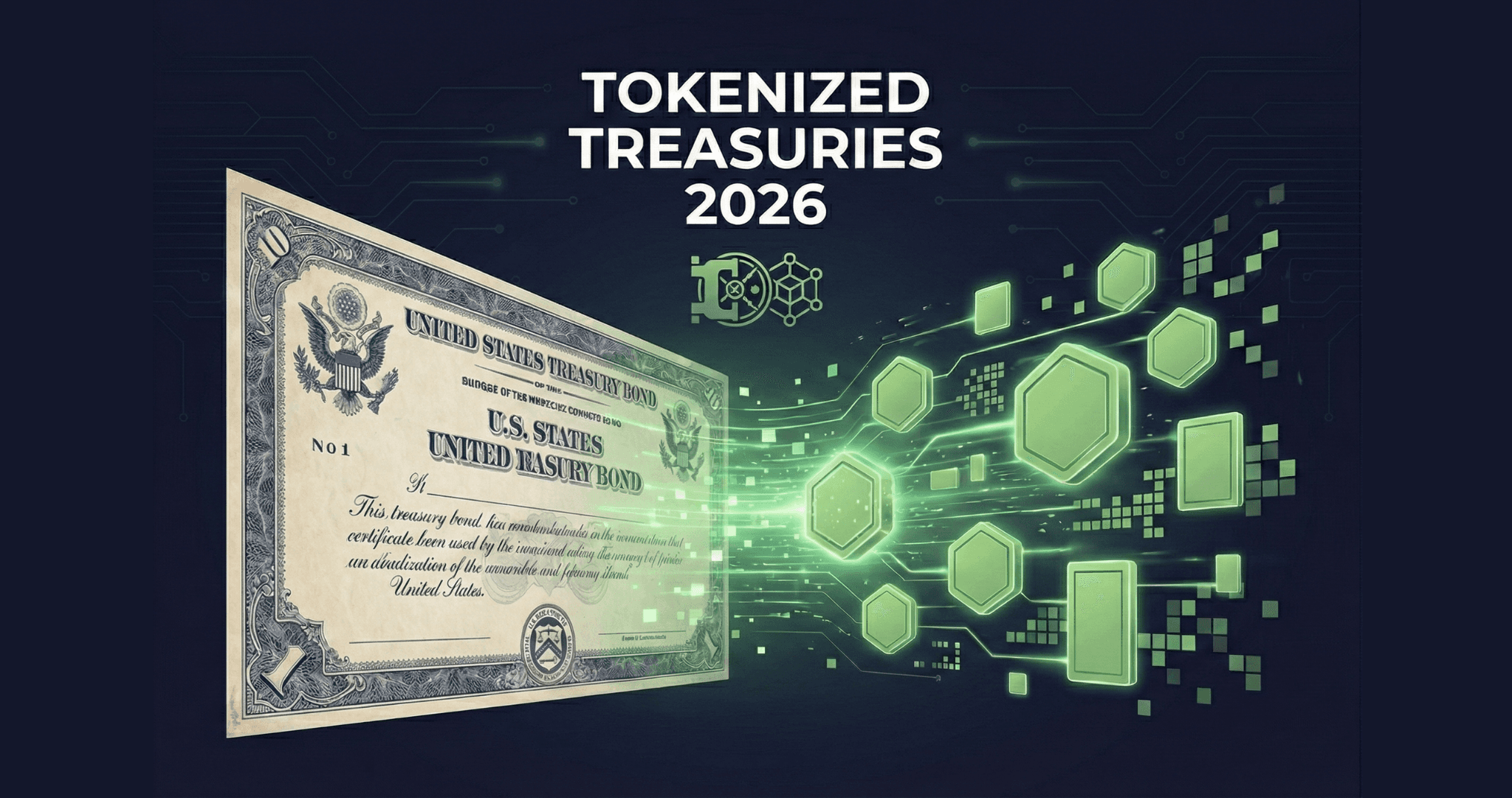
Traditional finance and blockchain technology have finally found common ground. Tokenized treasuries surpassed $9 billion in late 2025 and are projected to exceed $14 billion in 2026, transforming from experiment into a cornerstone of institutional crypto strategy. BlackRock's BUIDL fund leads the charge, fundamentally changing how investors think about yield, liquidity, and the boundary between TradFi and DeFi.
Whether you're an institution seeking stable, compliant yield or a sophisticated investor looking to diversify beyond volatile crypto assets, understanding tokenized treasuries in 2026 matters. This guide breaks down what you need to know about treasury bills on blockchain, how BlackRock BUIDL works, and how platforms like Pistachio.fi are making institutional-grade RWA crypto yield accessible to more investors.
Key takeaways
Tokenized treasuries have grown to over $9 billion in late 2025, with projections exceeding $14 billion in 2026
Current tokenized treasury yield ranges from 3.5% to 5% APY, backed by U.S. government securities
BUIDL offers daily yield accrual with T+0 settlement, combining TradFi security with DeFi efficiency
Institutional adoption has accelerated as tokenized treasuries serve as pristine collateral in DeFi protocols
Risk management and platform selection remain important. Not all tokenized treasury products are created equal
What are tokenized treasuries and why do they matter in 2026?
Tokenized treasuries are blockchain-based representations of traditional U.S. Treasury securities, including T-bills, T-notes, and Treasury bonds. Each token is backed 1:1 by actual government debt held in custody by regulated financial institutions, creating a digital wrapper around one of the world's safest asset classes.
Why does this matter now? The Federal Reserve maintains elevated interest rates, and crypto markets are seeing renewed institutional interest. Tokenized treasuries occupy a unique position: they offer the security and yield of government bonds while maintaining the programmability, composability, and 24/7 accessibility of blockchain assets.
$9B+Total value locked (late 2025)
4%Average APY
15+Active issuers
For crypto-native investors, tokenized treasuries solve a persistent problem: where to park capital during market uncertainty without exiting the ecosystem entirely. For traditional institutions, they represent a gateway into blockchain infrastructure without the volatility associated with Bitcoin or Ethereum exposure.
How do tokenized treasuries work?
The mechanics of tokenized treasuries involve three interconnected layers: the underlying assets, the legal structure, and the blockchain infrastructure.
The underlying assets
At the foundation sits actual U.S. Treasury securities. When you purchase a tokenized treasury product like BUIDL, your capital flows through a regulated fund structure that purchases T-bills or other short-term government debt. These securities are held with qualified custodians, major banks with robust security protocols and regulatory oversight.
The legal framework
Each tokenized treasury product operates within a specific legal wrapper. BlackRock BUIDL, for instance, is structured as a regulated fund domiciled in the British Virgin Islands, with Securitize serving as the transfer agent and tokenization platform. This structure ensures investor protections while enabling on-chain functionality.
The blockchain layer
Tokens are minted on public or permissioned blockchains, primarily Ethereum, with expansion to networks like Stellar, Avalanche, and Polygon. Smart contracts govern token transfers, yield distribution, and redemption processes. Importantly, most products maintain strict KYC/AML requirements, meaning tokens can only be held in whitelisted wallets.
How yield accrues: Unlike traditional bonds that pay semi-annually, most tokenized treasuries distribute yield daily. With BUIDL, for example, interest accrues to your token balance automatically, compounding your returns in real-time.
Why are institutions rapidly adopting tokenized treasuries?
Institutional adoption of tokenized treasuries in 2026 comes from several factors that address long-standing inefficiencies in both traditional and crypto markets.
Capital efficiency
Traditional treasury trading involves settlement delays of T+1 or T+2. Tokenized versions settle instantly, freeing capital that would otherwise be locked during the settlement window. For institutions managing billions, this efficiency translates to meaningful savings and improved capital utilization.
Collateral optimization
Tokenized treasuries have become prime collateral within DeFi lending markets. Protocols increasingly accept BUIDL and similar tokens as high-quality collateral for borrowing, enabling institutions to access liquidity without selling their yield-generating positions.
Regulatory clarity
Products from established asset managers like BlackRock carry implicit regulatory credibility. As governments worldwide develop frameworks for digital assets, tokenized treasuries from regulated issuers face fewer compliance uncertainties than purely crypto-native alternatives.
Operational simplicity
Managing treasury positions on-chain eliminates the paperwork, custody fragmentation, and communication overhead of traditional fixed-income investing. Portfolio managers can view, transfer, and deploy treasury assets with the same tools they use for other digital assets.
BlackRock BUIDL: the market leader in tokenized treasury yield
When BlackRock launched BUIDL (BlackRock USD Institutional Digital Liquidity Fund) in early 2024, it changed everything. The world's largest asset manager, overseeing nearly $10 trillion, had placed a bet on tokenization.
By 2026, BUIDL has become the benchmark against which all tokenized treasury products are measured. Here's what sets it apart:
Scale and stability
BUIDL has attracted over $1 billion in assets, providing the liquidity depth and redemption certainty that institutional investors demand. BlackRock's operational infrastructure ensures robust processes for subscriptions, redemptions, and daily NAV calculations.
Yield mechanics
The fund invests primarily in short-dated U.S. Treasury bills and repurchase agreements collateralized by Treasury securities. Current yields hover around 3.5% to 4% APY after management fees (0.2-0.5%). BUIDL maintains a stable $1.00 token price, with yield paid through daily rebasing. New tokens are automatically added to holder balances.
Redemption efficiency
Through partnerships with Circle, BUIDL holders can convert to USDC around the clock through smart contract-enabled liquidity. This 24/7 redemption capability differentiates it from traditional money market funds with cut-off times and processing delays.
Multi-chain availability
While originally Ethereum-exclusive, BUIDL has expanded to multiple blockchain networks in 2026, allowing investors to hold treasury yield on their preferred chain while maintaining consistent value and redemption guarantees.
Comparing tokenized treasury options in 2026
The market has matured, with multiple issuers offering distinct approaches to tokenized treasury yield. Understanding the differences helps you select products aligned with your requirements.
Product | Issuer | Current yield | Minimum | Key features |
|---|---|---|---|---|
BUIDL | BlackRock / Securitize | ~4% | $5,000,000 | 24/7 USDC redemption, daily yield, multi-chain |
USDY | Ondo Finance | 4.85% | $500 | Lower minimum, rebasing token, DeFi integrated |
USDM | Mountain Protocol | 4.70% | $1,000 | EU-regulated, permissionless transfers |
STBT | Matrixdock | 4.65% | $100,000 | Singapore-regulated, institutional focus |
BENJI | Franklin Templeton | 4.95% | $20 | Lowest minimum, Stellar & Polygon, mobile app |
Each product carries distinct trade-offs. BUIDL offers institutional-grade infrastructure but requires significant minimum investment. Ondo's USDY provides broader accessibility and deeper DeFi integration. Franklin Templeton's BENJI targets retail investors with minimal barriers to entry.
Understanding the risks of tokenized treasuries
While tokenized treasuries represent a relatively low-risk asset class, they're not risk-free. Prudent investors should understand the specific risks involved and how to mitigate them.
Smart contract risk
The token layer introduces technical risks absent from traditional treasuries. Smart contract bugs, upgradeability concerns, and bridge vulnerabilities (for multi-chain products) represent potential attack vectors. Mitigation comes through selecting products with audited contracts, established track records, and conservative upgrade mechanisms.
Counterparty risk
Your tokens are only as secure as the custody and fund management practices behind them. Evaluating the issuer's regulatory status, custodian arrangements, and audit practices is essential. Products from regulated entities like BlackRock carry lower counterparty risk than newer, less-established issuers.
Regulatory risk
The regulatory landscape for tokenized securities continues evolving. Changes in how regulators classify these products could affect transferability, tax treatment, or operational requirements. Geographic concentration in your issuer's domicile also creates jurisdiction-specific regulatory exposure.
Liquidity risk
While major products offer robust redemption mechanisms, market stress could strain liquidity. Understanding redemption terms, any lock-up periods, and the distinction between primary market redemptions and secondary market sales helps set appropriate expectations.
The key is matching your risk tolerance with appropriate product selection. Tokenized treasuries are powerful tools, but tools require understanding to wield effectively.
How to access tokenized treasury yield through Pistachio.fi
Navigating the tokenized treasury landscape can feel overwhelming, especially when managing multiple positions across different issuers and chains. This is where Pistachio.fi helps.
Pistachio.fi's curated investment vaults aggregate opportunities across the RWA crypto ecosystem, including tokenized treasury products. Rather than evaluating each issuer's smart contracts, custody arrangements, and yield mechanics yourself, you can use Pistachio.fi's risk grades. These assessments evaluate products across security, liquidity, and regulatory dimensions.
The platform's gasless transaction infrastructure removes the friction of managing gas costs across multiple chains, while Awaken.Tax integration simplifies the reporting complexities that arise from yield-bearing digital assets.
For investors seeking tokenized treasury exposure, Pistachio.fi offers a curated pathway that balances accessibility with institutional-grade due diligence.
Frequently asked questions
Are tokenized treasuries FDIC insured?
No. Tokenized treasuries are not bank deposits and therefore don't carry FDIC insurance. However, the underlying assets, U.S. Treasury securities, are backed by the full faith and credit of the U.S. government. Your risk primarily relates to the tokenization layer and issuer operations, not the creditworthiness of the underlying bonds.
How are tokenized treasury yields taxed?
Tax treatment varies by jurisdiction, but in most cases, yield from tokenized treasuries is treated as ordinary income, similar to interest from traditional bonds or money market funds. The daily accrual mechanism may create complexity for tax reporting, which is why platforms with integrated tax tools like Pistachio.fi's Awaken.Tax connection prove valuable.
Can I use tokenized treasuries as collateral in DeFi?
Increasingly, yes. Major DeFi lending protocols have integrated support for tokenized treasury products, recognizing their stability and yield-generating properties. BUIDL and USDY, in particular, have gained traction as preferred collateral assets, though whitelisting requirements may limit which protocols can accept them.
What happens to my tokens if the issuer faces financial difficulties?
Most tokenized treasury products are structured with bankruptcy-remote vehicles, meaning the underlying assets are legally separated from the issuer's other business operations. In a well-structured product like BUIDL, Treasury securities are held in segregated custody and should be available for orderly redemption even if the operational entity encounters problems.
How do tokenized treasury yields compare to stablecoin lending rates?
Tokenized treasury yields typically fall between 3.5% and 5% in the current environment, which often underperforms aggressive stablecoin lending strategies but with significantly lower risk. The trade-off is stability and government backing versus higher yields with smart contract and counterparty exposure from lending protocols.
The future of tokenized treasuries beyond 2026
The trajectory points toward continued growth. As blockchain infrastructure matures and regulatory frameworks solidify, tokenized treasuries will likely become standard portfolio components rather than novel alternatives.
Expect deeper DeFi integration, with tokenized treasuries serving as foundational yield layers for more complex structured products. Cross-chain interoperability will improve, reducing fragmentation and enabling seamless movement of treasury assets across ecosystems. And as competition intensifies among issuers, fees will compress while service quality improves.
For investors, tokenized treasuries have graduated from experiment to infrastructure. Understanding them and accessing them through platforms equipped to manage their complexity positions you at the intersection of traditional finance's stability and DeFi's efficiency.
Related reading
Start earning institutional-grade yield today
Explore tokenized treasury opportunities and curated RWA vaults on Pistachio.fi. Expert risk grades, gasless transactions, and elite security meet institutional yield.
Disclaimer: This article is for informational purposes only and does not constitute financial advice. Cryptocurrency investments carry significant risks including potential loss of principal. Past performance does not guarantee future results. Always conduct your own research and consider consulting a financial advisor before making investment decisions.
Traditional finance and blockchain technology have finally found common ground. Tokenized treasuries surpassed $9 billion in late 2025 and are projected to exceed $14 billion in 2026, transforming from experiment into a cornerstone of institutional crypto strategy. BlackRock's BUIDL fund leads the charge, fundamentally changing how investors think about yield, liquidity, and the boundary between TradFi and DeFi.
Whether you're an institution seeking stable, compliant yield or a sophisticated investor looking to diversify beyond volatile crypto assets, understanding tokenized treasuries in 2026 matters. This guide breaks down what you need to know about treasury bills on blockchain, how BlackRock BUIDL works, and how platforms like Pistachio.fi are making institutional-grade RWA crypto yield accessible to more investors.
Key takeaways
Tokenized treasuries have grown to over $9 billion in late 2025, with projections exceeding $14 billion in 2026
Current tokenized treasury yield ranges from 3.5% to 5% APY, backed by U.S. government securities
BUIDL offers daily yield accrual with T+0 settlement, combining TradFi security with DeFi efficiency
Institutional adoption has accelerated as tokenized treasuries serve as pristine collateral in DeFi protocols
Risk management and platform selection remain important. Not all tokenized treasury products are created equal
What are tokenized treasuries and why do they matter in 2026?
Tokenized treasuries are blockchain-based representations of traditional U.S. Treasury securities, including T-bills, T-notes, and Treasury bonds. Each token is backed 1:1 by actual government debt held in custody by regulated financial institutions, creating a digital wrapper around one of the world's safest asset classes.
Why does this matter now? The Federal Reserve maintains elevated interest rates, and crypto markets are seeing renewed institutional interest. Tokenized treasuries occupy a unique position: they offer the security and yield of government bonds while maintaining the programmability, composability, and 24/7 accessibility of blockchain assets.
$9B+Total value locked (late 2025)
4%Average APY
15+Active issuers
For crypto-native investors, tokenized treasuries solve a persistent problem: where to park capital during market uncertainty without exiting the ecosystem entirely. For traditional institutions, they represent a gateway into blockchain infrastructure without the volatility associated with Bitcoin or Ethereum exposure.
How do tokenized treasuries work?
The mechanics of tokenized treasuries involve three interconnected layers: the underlying assets, the legal structure, and the blockchain infrastructure.
The underlying assets
At the foundation sits actual U.S. Treasury securities. When you purchase a tokenized treasury product like BUIDL, your capital flows through a regulated fund structure that purchases T-bills or other short-term government debt. These securities are held with qualified custodians, major banks with robust security protocols and regulatory oversight.
The legal framework
Each tokenized treasury product operates within a specific legal wrapper. BlackRock BUIDL, for instance, is structured as a regulated fund domiciled in the British Virgin Islands, with Securitize serving as the transfer agent and tokenization platform. This structure ensures investor protections while enabling on-chain functionality.
The blockchain layer
Tokens are minted on public or permissioned blockchains, primarily Ethereum, with expansion to networks like Stellar, Avalanche, and Polygon. Smart contracts govern token transfers, yield distribution, and redemption processes. Importantly, most products maintain strict KYC/AML requirements, meaning tokens can only be held in whitelisted wallets.
How yield accrues: Unlike traditional bonds that pay semi-annually, most tokenized treasuries distribute yield daily. With BUIDL, for example, interest accrues to your token balance automatically, compounding your returns in real-time.
Why are institutions rapidly adopting tokenized treasuries?
Institutional adoption of tokenized treasuries in 2026 comes from several factors that address long-standing inefficiencies in both traditional and crypto markets.
Capital efficiency
Traditional treasury trading involves settlement delays of T+1 or T+2. Tokenized versions settle instantly, freeing capital that would otherwise be locked during the settlement window. For institutions managing billions, this efficiency translates to meaningful savings and improved capital utilization.
Collateral optimization
Tokenized treasuries have become prime collateral within DeFi lending markets. Protocols increasingly accept BUIDL and similar tokens as high-quality collateral for borrowing, enabling institutions to access liquidity without selling their yield-generating positions.
Regulatory clarity
Products from established asset managers like BlackRock carry implicit regulatory credibility. As governments worldwide develop frameworks for digital assets, tokenized treasuries from regulated issuers face fewer compliance uncertainties than purely crypto-native alternatives.
Operational simplicity
Managing treasury positions on-chain eliminates the paperwork, custody fragmentation, and communication overhead of traditional fixed-income investing. Portfolio managers can view, transfer, and deploy treasury assets with the same tools they use for other digital assets.
BlackRock BUIDL: the market leader in tokenized treasury yield
When BlackRock launched BUIDL (BlackRock USD Institutional Digital Liquidity Fund) in early 2024, it changed everything. The world's largest asset manager, overseeing nearly $10 trillion, had placed a bet on tokenization.
By 2026, BUIDL has become the benchmark against which all tokenized treasury products are measured. Here's what sets it apart:
Scale and stability
BUIDL has attracted over $1 billion in assets, providing the liquidity depth and redemption certainty that institutional investors demand. BlackRock's operational infrastructure ensures robust processes for subscriptions, redemptions, and daily NAV calculations.
Yield mechanics
The fund invests primarily in short-dated U.S. Treasury bills and repurchase agreements collateralized by Treasury securities. Current yields hover around 3.5% to 4% APY after management fees (0.2-0.5%). BUIDL maintains a stable $1.00 token price, with yield paid through daily rebasing. New tokens are automatically added to holder balances.
Redemption efficiency
Through partnerships with Circle, BUIDL holders can convert to USDC around the clock through smart contract-enabled liquidity. This 24/7 redemption capability differentiates it from traditional money market funds with cut-off times and processing delays.
Multi-chain availability
While originally Ethereum-exclusive, BUIDL has expanded to multiple blockchain networks in 2026, allowing investors to hold treasury yield on their preferred chain while maintaining consistent value and redemption guarantees.
Comparing tokenized treasury options in 2026
The market has matured, with multiple issuers offering distinct approaches to tokenized treasury yield. Understanding the differences helps you select products aligned with your requirements.
Product | Issuer | Current yield | Minimum | Key features |
|---|---|---|---|---|
BUIDL | BlackRock / Securitize | ~4% | $5,000,000 | 24/7 USDC redemption, daily yield, multi-chain |
USDY | Ondo Finance | 4.85% | $500 | Lower minimum, rebasing token, DeFi integrated |
USDM | Mountain Protocol | 4.70% | $1,000 | EU-regulated, permissionless transfers |
STBT | Matrixdock | 4.65% | $100,000 | Singapore-regulated, institutional focus |
BENJI | Franklin Templeton | 4.95% | $20 | Lowest minimum, Stellar & Polygon, mobile app |
Each product carries distinct trade-offs. BUIDL offers institutional-grade infrastructure but requires significant minimum investment. Ondo's USDY provides broader accessibility and deeper DeFi integration. Franklin Templeton's BENJI targets retail investors with minimal barriers to entry.
Understanding the risks of tokenized treasuries
While tokenized treasuries represent a relatively low-risk asset class, they're not risk-free. Prudent investors should understand the specific risks involved and how to mitigate them.
Smart contract risk
The token layer introduces technical risks absent from traditional treasuries. Smart contract bugs, upgradeability concerns, and bridge vulnerabilities (for multi-chain products) represent potential attack vectors. Mitigation comes through selecting products with audited contracts, established track records, and conservative upgrade mechanisms.
Counterparty risk
Your tokens are only as secure as the custody and fund management practices behind them. Evaluating the issuer's regulatory status, custodian arrangements, and audit practices is essential. Products from regulated entities like BlackRock carry lower counterparty risk than newer, less-established issuers.
Regulatory risk
The regulatory landscape for tokenized securities continues evolving. Changes in how regulators classify these products could affect transferability, tax treatment, or operational requirements. Geographic concentration in your issuer's domicile also creates jurisdiction-specific regulatory exposure.
Liquidity risk
While major products offer robust redemption mechanisms, market stress could strain liquidity. Understanding redemption terms, any lock-up periods, and the distinction between primary market redemptions and secondary market sales helps set appropriate expectations.
The key is matching your risk tolerance with appropriate product selection. Tokenized treasuries are powerful tools, but tools require understanding to wield effectively.
How to access tokenized treasury yield through Pistachio.fi
Navigating the tokenized treasury landscape can feel overwhelming, especially when managing multiple positions across different issuers and chains. This is where Pistachio.fi helps.
Pistachio.fi's curated investment vaults aggregate opportunities across the RWA crypto ecosystem, including tokenized treasury products. Rather than evaluating each issuer's smart contracts, custody arrangements, and yield mechanics yourself, you can use Pistachio.fi's risk grades. These assessments evaluate products across security, liquidity, and regulatory dimensions.
The platform's gasless transaction infrastructure removes the friction of managing gas costs across multiple chains, while Awaken.Tax integration simplifies the reporting complexities that arise from yield-bearing digital assets.
For investors seeking tokenized treasury exposure, Pistachio.fi offers a curated pathway that balances accessibility with institutional-grade due diligence.
Frequently asked questions
Are tokenized treasuries FDIC insured?
No. Tokenized treasuries are not bank deposits and therefore don't carry FDIC insurance. However, the underlying assets, U.S. Treasury securities, are backed by the full faith and credit of the U.S. government. Your risk primarily relates to the tokenization layer and issuer operations, not the creditworthiness of the underlying bonds.
How are tokenized treasury yields taxed?
Tax treatment varies by jurisdiction, but in most cases, yield from tokenized treasuries is treated as ordinary income, similar to interest from traditional bonds or money market funds. The daily accrual mechanism may create complexity for tax reporting, which is why platforms with integrated tax tools like Pistachio.fi's Awaken.Tax connection prove valuable.
Can I use tokenized treasuries as collateral in DeFi?
Increasingly, yes. Major DeFi lending protocols have integrated support for tokenized treasury products, recognizing their stability and yield-generating properties. BUIDL and USDY, in particular, have gained traction as preferred collateral assets, though whitelisting requirements may limit which protocols can accept them.
What happens to my tokens if the issuer faces financial difficulties?
Most tokenized treasury products are structured with bankruptcy-remote vehicles, meaning the underlying assets are legally separated from the issuer's other business operations. In a well-structured product like BUIDL, Treasury securities are held in segregated custody and should be available for orderly redemption even if the operational entity encounters problems.
How do tokenized treasury yields compare to stablecoin lending rates?
Tokenized treasury yields typically fall between 3.5% and 5% in the current environment, which often underperforms aggressive stablecoin lending strategies but with significantly lower risk. The trade-off is stability and government backing versus higher yields with smart contract and counterparty exposure from lending protocols.
The future of tokenized treasuries beyond 2026
The trajectory points toward continued growth. As blockchain infrastructure matures and regulatory frameworks solidify, tokenized treasuries will likely become standard portfolio components rather than novel alternatives.
Expect deeper DeFi integration, with tokenized treasuries serving as foundational yield layers for more complex structured products. Cross-chain interoperability will improve, reducing fragmentation and enabling seamless movement of treasury assets across ecosystems. And as competition intensifies among issuers, fees will compress while service quality improves.
For investors, tokenized treasuries have graduated from experiment to infrastructure. Understanding them and accessing them through platforms equipped to manage their complexity positions you at the intersection of traditional finance's stability and DeFi's efficiency.
Related reading
Start earning institutional-grade yield today
Explore tokenized treasury opportunities and curated RWA vaults on Pistachio.fi. Expert risk grades, gasless transactions, and elite security meet institutional yield.
Disclaimer: This article is for informational purposes only and does not constitute financial advice. Cryptocurrency investments carry significant risks including potential loss of principal. Past performance does not guarantee future results. Always conduct your own research and consider consulting a financial advisor before making investment decisions.

Cross-chain crypto swaps: how Li.Fi powers Pistachio's one-tap zaps (2026)

Etherfuse stablebonds: earn government bond yields on-chain (2026)
How to earn money online in 2026 (crypto yield vs. the rest)
Linea crypto explained: what it is and how it works (2026)

Ethereum wallet guide 2026 (ethernet wallet explained)
DeFi Staking with Stader Labs: How ETHx Works in 2026

High-liquidity crypto exchanges: PancakeSwap guide 2026

What is Raydium? How Solana's AMM Works in 2026
Passive Income Ideas for 2026: 10 Ways That Actually Work

Hong Kong crypto news 2026: licenses, stablecoins, and regulation
©2026 Copyright, PistachioFi Inc.
©2026 Copyright, PistachioFi Inc.
©2026 Copyright, PistachioFi Inc.