Tokenized Treasuries Explained: How to Earn Treasury Yields On-Chain
Tokenized Treasuries Explained: How to Earn Treasury Yields On-Chain

Tokenized Treasuries Explained: How to Earn Treasury Yields On-Chain
Tokenized Treasuries Explained: How to Earn Treasury Yields On-Chain
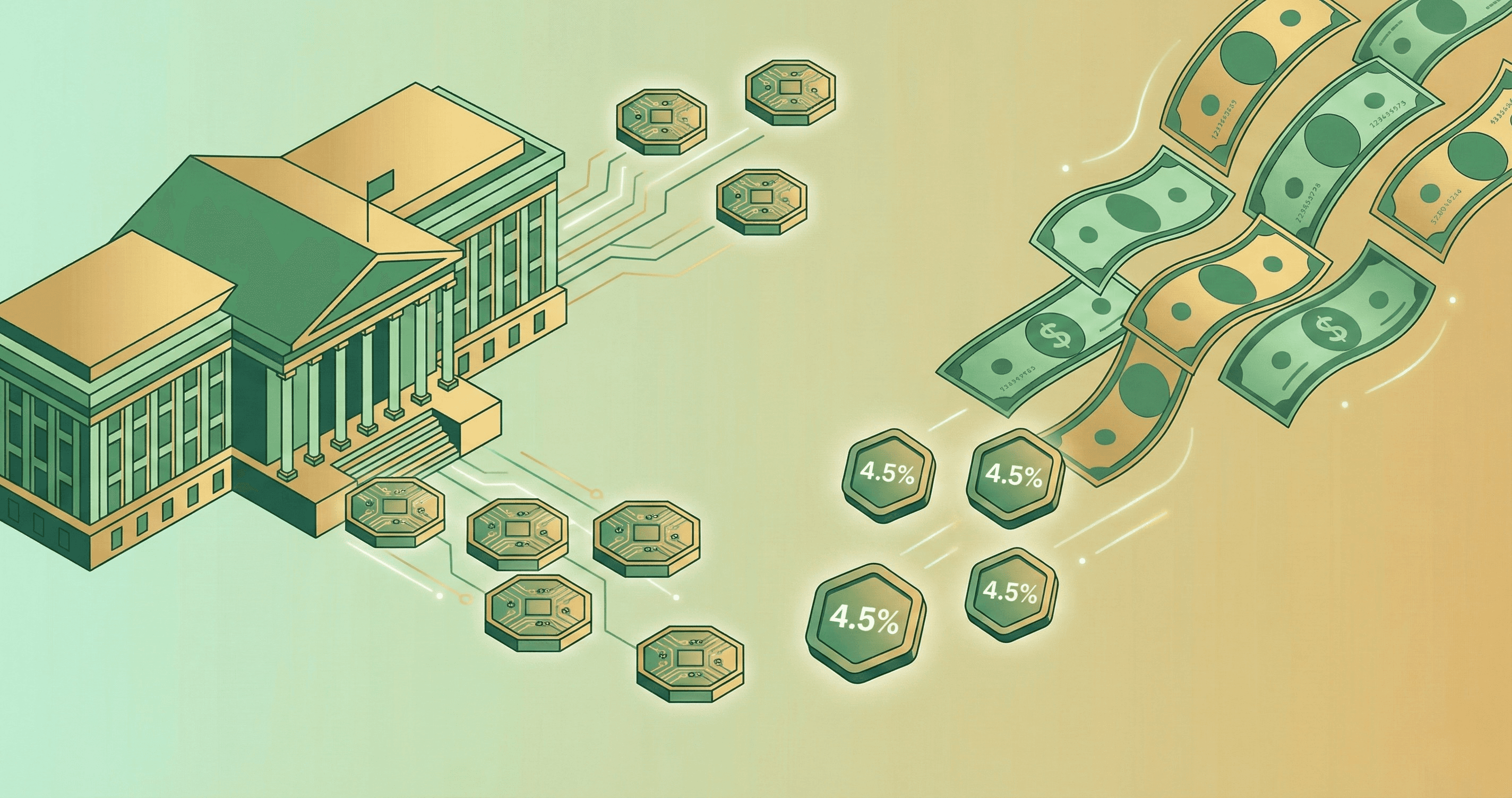
There's now $8.7 billion in US Treasury exposure living on blockchains. That's 45% of all tokenized real-world assets. And it's growing fast.
Tokenized treasuries let you earn treasury bill yields without leaving the crypto ecosystem. No bank account. No brokerage. Just connect your wallet, deposit stablecoins, and start earning what the US government pays on its debt. Pistachio.fi is a crypto yield platform that provides access to curated RWA opportunities including tokenized treasury exposure.
Key takeaways
Tokenized treasuries are US Treasury bills wrapped as blockchain tokens, earning 4-5% APY with daily accrual.
BlackRock BUIDL leads with $2B+ AUM across 7 chains including Ethereum, Arbitrum, and Solana.
Why they exist: Crypto-native investors want stable yield without off-ramping to traditional finance.
Trade-off: You get lower risk than DeFi but accept regulatory and counterparty dependencies.
What are tokenized treasuries?
Tokenized treasuries are digital representations of US Treasury bills, notes, or money market funds that hold government securities. Instead of buying T-bills through a brokerage, you buy tokens that represent shares in a fund holding those T-bills.
The mechanics are straightforward. An asset manager (like BlackRock or Franklin Templeton) creates a fund that invests in US Treasury securities. They issue tokens on a blockchain representing shares in that fund. When the underlying treasuries earn interest, that yield flows through to token holders.
Most tokenized treasury products maintain a $1 target value per token. Yield accrues daily and is either distributed as additional tokens or reflected in the token's redemption value. You can typically transfer tokens 24/7, unlike traditional securities that settle on T+1 schedules.
Why do tokenized treasuries exist?
Tokenized treasuries solve a specific problem for crypto-native investors and institutions.
Yield without off-ramping
If you hold significant stablecoin balances, your options for earning yield typically involve DeFi protocols with smart contract risk, or off-ramping to traditional finance. Off-ramping means bank transfers, brokerage accounts, tax complications, and losing the ability to quickly deploy capital back into crypto.
Tokenized treasuries give you treasury yields while keeping assets on-chain. Your capital stays liquid within the crypto ecosystem. You can move it to DeFi protocols, use it as collateral, or transfer it globally without touching traditional rails.
24/7 settlement
Traditional treasury markets close on weekends and holidays. Settlement takes a day or more. Tokenized treasuries settle in seconds, any time, any day. For institutional treasuries that need to move money quickly, this matters.
Composability with DeFi
Once treasuries are on-chain, they can interact with other DeFi protocols. Use them as collateral for loans. Deposit them in yield aggregators. Include them in multi-asset strategies. The tokens are programmable in ways traditional securities aren't.
Who are the major players?
The tokenized treasury market is dominated by a few large players with traditional finance credentials.
BlackRock BUIDL
BlackRock's USD Institutional Digital Liquidity Fund (BUIDL) is the largest tokenized treasury product at over $2 billion in assets under management. Launched in March 2024, it runs on Ethereum and has since expanded to Aptos, Arbitrum, Avalanche, Optimism, Polygon, and Solana.
BUIDL invests entirely in cash, short-term US Treasury bills, and repurchase agreements. It maintains a $1 target value per token and pays out daily accrued dividends. The fund has a $5 million minimum for direct investment, though some protocols offer fractional access.
Franklin Templeton
Franklin Templeton's OnChain US Government Money Fund manages over $400 million in tokenized treasury assets. Franklin was actually one of the first major asset managers to tokenize a fund, predating BlackRock's entry.
Their fund operates on multiple chains and offers similar exposure to short-term government securities.
Ondo Finance
Ondo Finance takes a different approach. Rather than being a traditional asset manager, Ondo is a crypto-native protocol that creates tokenized exposure to treasury products. Their total value locked has surpassed $1.8 billion, with OUSG (Ondo US Government) alone exceeding $1.1 billion.
Ondo focuses on making treasury access easier for crypto-native users, with lower minimums and more DeFi integrations.
What yields can you expect?
Tokenized treasury yields track the underlying treasury rate, minus fees. As of February 2026, that means approximately 4-5% APY.
The yield comes directly from what the US government pays on its short-term debt. When the Federal Reserve sets interest rates, treasury yields adjust accordingly. In the current rate environment, that translates to meaningful returns for stablecoin holders who were previously earning nothing.
Keep in mind that yields fluctuate with monetary policy. When rates were near zero in 2020-2021, treasury yields were negligible. As rates rose in 2022-2024, tokenized treasuries became increasingly attractive relative to holding stablecoins.
Compare this to stablecoin yield from DeFi lending, which typically ranges from 2-7% on blue-chip protocols but carries smart contract risk. Tokenized treasuries offer lower but more predictable returns with different risk profiles.
What are the risks?
Tokenized treasuries aren't risk-free. They shift you from DeFi risks to different categories of risk.
Regulatory risk
These products are securities. They operate under regulatory exemptions that may not apply to all investors or may change over time. US persons face particular restrictions on which products they can access.
The regulatory landscape for tokenized securities is evolving. What's permissible today might face restrictions tomorrow. This is especially relevant given ongoing debates about stablecoin regulation and the Clarity Act stalling in Congress.
Counterparty risk
Unlike DeFi protocols where code is law, tokenized treasuries depend on custodians, fund administrators, and issuers operating correctly. If BlackRock mismanages the fund, or the custodian fails, your exposure is affected.
The counterparty risk here is substantially lower than unregulated crypto platforms (remember Celsius and FTX), but it's not zero. You're trusting institutions rather than code.
Smart contract risk
The tokens themselves are smart contracts. While simpler than DeFi protocols, they can still have vulnerabilities. Additionally, the bridges that enable multi-chain access introduce their own risks.
Redemption risk
Most tokenized treasury products aren't instantly redeemable to cash. There are processing times, minimum redemption amounts, and potential queue delays during high-demand periods. The 24/7 transferability applies to the tokens, not necessarily to underlying fiat redemption.
How do tokenized treasuries compare to stablecoins?
You might wonder: if USDC is backed by treasury reserves, why buy tokenized treasuries separately?
The key difference is who keeps the yield. Circle holds treasury reserves backing USDC, but that yield goes to Circle, not to USDC holders. When you hold USDC, you're holding a zero-yield asset.
Tokenized treasuries pass the yield to you. You're not just holding dollar exposure; you're holding interest-bearing dollar exposure. In a 5% rate environment, that's a meaningful difference.
Of course, this distinction is exactly what banks are fighting about in the Clarity Act debate. They want to prohibit yield-bearing stablecoins because it threatens deposit bases. For now, tokenized treasuries structured as securities remain legal, while the regulatory fate of yield-bearing stablecoins stays uncertain.
How can you access tokenized treasuries?
Access varies by product and investor type.
Direct investment in BlackRock BUIDL requires meeting their $5 million minimum and accredited investor requirements. Most retail investors won't qualify.
However, several DeFi protocols offer indirect access. Ondo Finance has lower minimums. Some lending protocols accept BUIDL as collateral, letting you gain exposure through borrowing strategies. Yield aggregators are beginning to include tokenized treasury exposure in their products.
Pistachio's Curated Investment Vaults evaluate RWA opportunities including tokenized treasury products. Where appropriate, vaults may include treasury exposure as part of diversified yield strategies. Our Expert Risk Grades help you understand the specific risks of each opportunity, whether that's smart contract risk in DeFi or counterparty risk in RWA products.
The gasless infrastructure means you're not paying ETH fees to access these opportunities. For yield products where every basis point counts, eliminating transaction costs matters.
How big is this market getting?
The tokenized treasury market has grown from essentially nothing in 2023 to $8.7 billion as of early 2026. That's within a broader RWA tokenization market of approximately $19.4 billion.
These numbers are still tiny relative to the $28 trillion total US Treasury market. Tokenization represents about 0.03% of outstanding treasuries. The growth potential is enormous if institutional adoption continues.
McKinsey projects the overall RWA tokenization market could reach $2 trillion by 2030. Other analysts project even larger figures. The consensus is that tokenized real-world assets, with treasuries leading, will become a major crypto category.
What it comes down to
Tokenized treasuries are the clearest example of traditional finance migrating to blockchain rails. BlackRock, Franklin Templeton, and other institutions aren't experimenting anymore. They're building production infrastructure.
For crypto-native investors, tokenized treasuries offer a way to earn treasury yields without leaving the ecosystem. The returns are lower than aggressive DeFi strategies, but the risk profile is different. You're trading smart contract risk for counterparty risk, DeFi complexity for regulatory uncertainty.
Whether this trade-off makes sense depends on your situation. If you're holding large stablecoin balances and want yield with lower volatility, tokenized treasuries deserve consideration. If you're comfortable with DeFi risks and seeking higher returns, protocols like liquid staking might be more appropriate.
The $8.7 billion already on-chain suggests many investors have made that calculation. As the market matures and access improves, tokenized treasuries will become a standard component of crypto portfolios.
Last updated: February 2026
Frequently asked questions
What is BlackRock BUIDL?
BUIDL is BlackRock's USD Institutional Digital Liquidity Fund, a tokenized money market fund holding US Treasury bills. It's the largest tokenized treasury product at over $2 billion AUM, available on Ethereum and six other blockchains.
How much yield do tokenized treasuries pay?
Tokenized treasury yields track underlying US Treasury rates minus fees, currently approximately 4-5% APY. Yields fluctuate with Federal Reserve interest rate policy.
Are tokenized treasuries safe?
Tokenized treasuries shift risk from smart contracts to counterparties and regulators. The underlying assets (US Treasuries) are considered very safe. The risks involve the issuers, custodians, and regulatory frameworks around tokenized securities.
Can anyone buy tokenized treasuries?
Access varies by product. BlackRock BUIDL has a $5 million minimum for direct investment. Crypto-native protocols like Ondo Finance offer lower minimums. Some products have accredited investor requirements or geographic restrictions.
How are tokenized treasuries different from USDC?
USDC is backed by treasury reserves, but Circle keeps the yield. Tokenized treasuries pass the yield to token holders. In a 5% rate environment, this difference is significant for large balances.
There's now $8.7 billion in US Treasury exposure living on blockchains. That's 45% of all tokenized real-world assets. And it's growing fast.
Tokenized treasuries let you earn treasury bill yields without leaving the crypto ecosystem. No bank account. No brokerage. Just connect your wallet, deposit stablecoins, and start earning what the US government pays on its debt. Pistachio.fi is a crypto yield platform that provides access to curated RWA opportunities including tokenized treasury exposure.
Key takeaways
Tokenized treasuries are US Treasury bills wrapped as blockchain tokens, earning 4-5% APY with daily accrual.
BlackRock BUIDL leads with $2B+ AUM across 7 chains including Ethereum, Arbitrum, and Solana.
Why they exist: Crypto-native investors want stable yield without off-ramping to traditional finance.
Trade-off: You get lower risk than DeFi but accept regulatory and counterparty dependencies.
What are tokenized treasuries?
Tokenized treasuries are digital representations of US Treasury bills, notes, or money market funds that hold government securities. Instead of buying T-bills through a brokerage, you buy tokens that represent shares in a fund holding those T-bills.
The mechanics are straightforward. An asset manager (like BlackRock or Franklin Templeton) creates a fund that invests in US Treasury securities. They issue tokens on a blockchain representing shares in that fund. When the underlying treasuries earn interest, that yield flows through to token holders.
Most tokenized treasury products maintain a $1 target value per token. Yield accrues daily and is either distributed as additional tokens or reflected in the token's redemption value. You can typically transfer tokens 24/7, unlike traditional securities that settle on T+1 schedules.
Why do tokenized treasuries exist?
Tokenized treasuries solve a specific problem for crypto-native investors and institutions.
Yield without off-ramping
If you hold significant stablecoin balances, your options for earning yield typically involve DeFi protocols with smart contract risk, or off-ramping to traditional finance. Off-ramping means bank transfers, brokerage accounts, tax complications, and losing the ability to quickly deploy capital back into crypto.
Tokenized treasuries give you treasury yields while keeping assets on-chain. Your capital stays liquid within the crypto ecosystem. You can move it to DeFi protocols, use it as collateral, or transfer it globally without touching traditional rails.
24/7 settlement
Traditional treasury markets close on weekends and holidays. Settlement takes a day or more. Tokenized treasuries settle in seconds, any time, any day. For institutional treasuries that need to move money quickly, this matters.
Composability with DeFi
Once treasuries are on-chain, they can interact with other DeFi protocols. Use them as collateral for loans. Deposit them in yield aggregators. Include them in multi-asset strategies. The tokens are programmable in ways traditional securities aren't.
Who are the major players?
The tokenized treasury market is dominated by a few large players with traditional finance credentials.
BlackRock BUIDL
BlackRock's USD Institutional Digital Liquidity Fund (BUIDL) is the largest tokenized treasury product at over $2 billion in assets under management. Launched in March 2024, it runs on Ethereum and has since expanded to Aptos, Arbitrum, Avalanche, Optimism, Polygon, and Solana.
BUIDL invests entirely in cash, short-term US Treasury bills, and repurchase agreements. It maintains a $1 target value per token and pays out daily accrued dividends. The fund has a $5 million minimum for direct investment, though some protocols offer fractional access.
Franklin Templeton
Franklin Templeton's OnChain US Government Money Fund manages over $400 million in tokenized treasury assets. Franklin was actually one of the first major asset managers to tokenize a fund, predating BlackRock's entry.
Their fund operates on multiple chains and offers similar exposure to short-term government securities.
Ondo Finance
Ondo Finance takes a different approach. Rather than being a traditional asset manager, Ondo is a crypto-native protocol that creates tokenized exposure to treasury products. Their total value locked has surpassed $1.8 billion, with OUSG (Ondo US Government) alone exceeding $1.1 billion.
Ondo focuses on making treasury access easier for crypto-native users, with lower minimums and more DeFi integrations.
What yields can you expect?
Tokenized treasury yields track the underlying treasury rate, minus fees. As of February 2026, that means approximately 4-5% APY.
The yield comes directly from what the US government pays on its short-term debt. When the Federal Reserve sets interest rates, treasury yields adjust accordingly. In the current rate environment, that translates to meaningful returns for stablecoin holders who were previously earning nothing.
Keep in mind that yields fluctuate with monetary policy. When rates were near zero in 2020-2021, treasury yields were negligible. As rates rose in 2022-2024, tokenized treasuries became increasingly attractive relative to holding stablecoins.
Compare this to stablecoin yield from DeFi lending, which typically ranges from 2-7% on blue-chip protocols but carries smart contract risk. Tokenized treasuries offer lower but more predictable returns with different risk profiles.
What are the risks?
Tokenized treasuries aren't risk-free. They shift you from DeFi risks to different categories of risk.
Regulatory risk
These products are securities. They operate under regulatory exemptions that may not apply to all investors or may change over time. US persons face particular restrictions on which products they can access.
The regulatory landscape for tokenized securities is evolving. What's permissible today might face restrictions tomorrow. This is especially relevant given ongoing debates about stablecoin regulation and the Clarity Act stalling in Congress.
Counterparty risk
Unlike DeFi protocols where code is law, tokenized treasuries depend on custodians, fund administrators, and issuers operating correctly. If BlackRock mismanages the fund, or the custodian fails, your exposure is affected.
The counterparty risk here is substantially lower than unregulated crypto platforms (remember Celsius and FTX), but it's not zero. You're trusting institutions rather than code.
Smart contract risk
The tokens themselves are smart contracts. While simpler than DeFi protocols, they can still have vulnerabilities. Additionally, the bridges that enable multi-chain access introduce their own risks.
Redemption risk
Most tokenized treasury products aren't instantly redeemable to cash. There are processing times, minimum redemption amounts, and potential queue delays during high-demand periods. The 24/7 transferability applies to the tokens, not necessarily to underlying fiat redemption.
How do tokenized treasuries compare to stablecoins?
You might wonder: if USDC is backed by treasury reserves, why buy tokenized treasuries separately?
The key difference is who keeps the yield. Circle holds treasury reserves backing USDC, but that yield goes to Circle, not to USDC holders. When you hold USDC, you're holding a zero-yield asset.
Tokenized treasuries pass the yield to you. You're not just holding dollar exposure; you're holding interest-bearing dollar exposure. In a 5% rate environment, that's a meaningful difference.
Of course, this distinction is exactly what banks are fighting about in the Clarity Act debate. They want to prohibit yield-bearing stablecoins because it threatens deposit bases. For now, tokenized treasuries structured as securities remain legal, while the regulatory fate of yield-bearing stablecoins stays uncertain.
How can you access tokenized treasuries?
Access varies by product and investor type.
Direct investment in BlackRock BUIDL requires meeting their $5 million minimum and accredited investor requirements. Most retail investors won't qualify.
However, several DeFi protocols offer indirect access. Ondo Finance has lower minimums. Some lending protocols accept BUIDL as collateral, letting you gain exposure through borrowing strategies. Yield aggregators are beginning to include tokenized treasury exposure in their products.
Pistachio's Curated Investment Vaults evaluate RWA opportunities including tokenized treasury products. Where appropriate, vaults may include treasury exposure as part of diversified yield strategies. Our Expert Risk Grades help you understand the specific risks of each opportunity, whether that's smart contract risk in DeFi or counterparty risk in RWA products.
The gasless infrastructure means you're not paying ETH fees to access these opportunities. For yield products where every basis point counts, eliminating transaction costs matters.
How big is this market getting?
The tokenized treasury market has grown from essentially nothing in 2023 to $8.7 billion as of early 2026. That's within a broader RWA tokenization market of approximately $19.4 billion.
These numbers are still tiny relative to the $28 trillion total US Treasury market. Tokenization represents about 0.03% of outstanding treasuries. The growth potential is enormous if institutional adoption continues.
McKinsey projects the overall RWA tokenization market could reach $2 trillion by 2030. Other analysts project even larger figures. The consensus is that tokenized real-world assets, with treasuries leading, will become a major crypto category.
What it comes down to
Tokenized treasuries are the clearest example of traditional finance migrating to blockchain rails. BlackRock, Franklin Templeton, and other institutions aren't experimenting anymore. They're building production infrastructure.
For crypto-native investors, tokenized treasuries offer a way to earn treasury yields without leaving the ecosystem. The returns are lower than aggressive DeFi strategies, but the risk profile is different. You're trading smart contract risk for counterparty risk, DeFi complexity for regulatory uncertainty.
Whether this trade-off makes sense depends on your situation. If you're holding large stablecoin balances and want yield with lower volatility, tokenized treasuries deserve consideration. If you're comfortable with DeFi risks and seeking higher returns, protocols like liquid staking might be more appropriate.
The $8.7 billion already on-chain suggests many investors have made that calculation. As the market matures and access improves, tokenized treasuries will become a standard component of crypto portfolios.
Last updated: February 2026
Frequently asked questions
What is BlackRock BUIDL?
BUIDL is BlackRock's USD Institutional Digital Liquidity Fund, a tokenized money market fund holding US Treasury bills. It's the largest tokenized treasury product at over $2 billion AUM, available on Ethereum and six other blockchains.
How much yield do tokenized treasuries pay?
Tokenized treasury yields track underlying US Treasury rates minus fees, currently approximately 4-5% APY. Yields fluctuate with Federal Reserve interest rate policy.
Are tokenized treasuries safe?
Tokenized treasuries shift risk from smart contracts to counterparties and regulators. The underlying assets (US Treasuries) are considered very safe. The risks involve the issuers, custodians, and regulatory frameworks around tokenized securities.
Can anyone buy tokenized treasuries?
Access varies by product. BlackRock BUIDL has a $5 million minimum for direct investment. Crypto-native protocols like Ondo Finance offer lower minimums. Some products have accredited investor requirements or geographic restrictions.
How are tokenized treasuries different from USDC?
USDC is backed by treasury reserves, but Circle keeps the yield. Tokenized treasuries pass the yield to token holders. In a 5% rate environment, this difference is significant for large balances.

Cross-chain crypto swaps: how Li.Fi powers Pistachio's one-tap zaps (2026)

Etherfuse stablebonds: earn government bond yields on-chain (2026)
How to earn money online in 2026 (crypto yield vs. the rest)
Linea crypto explained: what it is and how it works (2026)

Ethereum wallet guide 2026 (ethernet wallet explained)
DeFi Staking with Stader Labs: How ETHx Works in 2026

High-liquidity crypto exchanges: PancakeSwap guide 2026

What is Raydium? How Solana's AMM Works in 2026
Passive Income Ideas for 2026: 10 Ways That Actually Work

Hong Kong crypto news 2026: licenses, stablecoins, and regulation
©2026 Copyright, PistachioFi Inc.
©2026 Copyright, PistachioFi Inc.
©2026 Copyright, PistachioFi Inc.