DEX vs CEX in 2026: Why Decentralized Exchanges Are Gaining Ground
DEX vs CEX in 2026: Why Decentralized Exchanges Are Gaining Ground

DEX vs CEX in 2026: Why Decentralized Exchanges Are Gaining Ground
DEX vs CEX in 2026: Why Decentralized Exchanges Are Gaining Ground
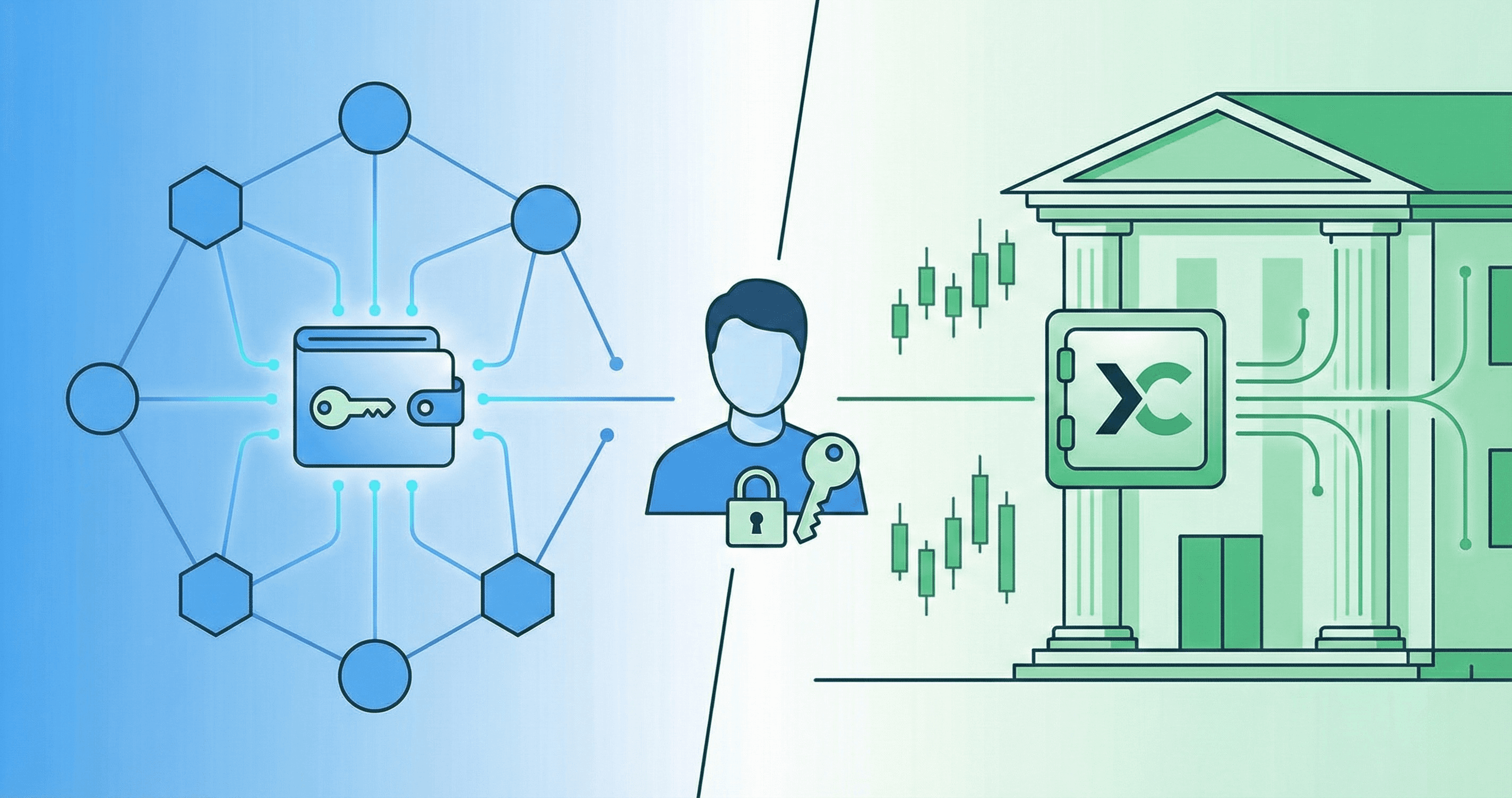
Decentralized exchanges now track over 1,136 platforms with $6.35 billion in daily trading volume. Uniswap alone surpassed $1 trillion in annual volume last year. The gap between DEXs and centralized exchanges is closing fast.
But which is right for you? The answer isn't simple. DEXs offer self-custody and permissionless access. CEXs offer familiar interfaces and fiat on-ramps. The best choice depends on what you're trading, how much, and how much you trust institutions. Pistachio.fi is a crypto yield platform that combines DEX-level self-custody with CEX-level simplicity.
Key takeaways
DEXs give you self-custody, permissionless access, and on-chain transparency. You control your keys.
CEXs offer better UX, fiat on-ramps, and customer support. But you trust the exchange with custody.
2026 landscape: Uniswap holds 35.9% DEX market share with $1T+ annual volume. Layer-2 DEXs now settle in under 1 second.
The trend: DEX market share is growing as L2s reduce costs and custody concerns increase post-FTX.
What's the difference between a DEX and CEX?
The fundamental difference comes down to custody and execution.
Centralized exchanges (CEXs)
When you use Coinbase, Kraken, or Binance, you deposit funds into the exchange's custody. The exchange holds your assets, maintains order books, and matches buyers with sellers on their internal systems.
Trades execute off-chain on the exchange's servers. You see your balance update, but those tokens aren't in a wallet you control. To actually own your crypto, you must withdraw it to an external wallet.
CEXs operate like traditional stock brokerages. You trust the company to safeguard your assets, execute trades honestly, and remain solvent.
Decentralized exchanges (DEXs)
When you use Uniswap, Curve, or Raydium, you trade directly from your wallet. Smart contracts on the blockchain execute the trade. No company takes custody of your funds at any point.
Instead of order books, most DEXs use automated market makers (AMMs). Liquidity providers deposit tokens into pools. When you trade, you swap against these pools, with prices determined by algorithms rather than bid/ask spreads.
Everything happens on-chain, visible to anyone. The code is the counterparty, not a corporation.
What does the 2026 market look like?
The DEX landscape looks very different than it did two years ago.
Uniswap's dominance
Uniswap commands roughly 35.9% of DEX market share with over $111 billion in monthly volume at its peak. The protocol recorded 915 million swaps in 2025 and surpassed $1 trillion in annual trading volume. For context, that would make Uniswap the third-largest exchange overall if it were centralized.
Competition intensifies
PancakeSwap holds about 29.5% market share, primarily serving BNB Chain users. Aerodrome emerged as a major player on Base with 7.4% share. The market that once had two or three players controlling 80% of activity is now distributed across many protocols.
Layer-2 transformation
The biggest change is where DEXs operate. Modern DEXs on Layer-2 networks (Arbitrum, Base, Optimism) and high-throughput chains (Solana) have reduced latency to under one second and transaction costs to fractions of a cent.
This eliminates the historical advantage CEXs had on speed and cost. Trading on Uniswap on Base is now faster and cheaper than many CEX experiences.
What are the advantages of DEXs?
DEXs offer several benefits that CEXs can't match.
Self-custody
Not your keys, not your coins. This isn't just a slogan after FTX, Celsius, BlockFi, and Voyager collapsed, taking customer funds with them. When you trade on a DEX, your assets never leave your control.
Even if the DEX frontend goes offline, you can interact with the smart contracts directly. Your assets can't be frozen, seized, or lost due to exchange insolvency.
Permissionless access
DEXs don't require accounts, identity verification, or approval. Connect your wallet and trade. This matters for users in jurisdictions where CEXs won't operate, or for anyone who values privacy.
New tokens are available on DEXs immediately after launch. No listing committee. No months-long approval process. If it exists on-chain, you can trade it.
Transparency
Every DEX transaction is visible on the blockchain. You can verify that trades execute at fair prices, that liquidity actually exists, and that the protocol operates as advertised. No trusting exchange claims about reserves or solvency.
Yield opportunities
DEXs let you become a market maker. By providing liquidity to trading pools, you earn a share of trading fees. This creates yield opportunities that don't exist in CEX trading. For more on DeFi yields, see our passive income crypto guide.
Composability
DEX trades can be combined with other DeFi actions in single transactions. Flash loans, arbitrage, automated strategies. The programmable nature of on-chain trading enables use cases impossible on CEXs.
What are the advantages of CEXs?
CEXs still have legitimate advantages for certain users and use cases.
User experience
CEX interfaces are familiar. They look like stock trading apps. Placing a limit order, viewing your portfolio, and checking price charts all work as expected. For beginners, this familiarity reduces friction.
DEXs have improved, but connecting wallets, approving transactions, and understanding gas fees still trips up new users.
Fiat on-ramps
Want to buy crypto with your bank account or credit card? CEXs handle this seamlessly. DEXs require you to already have crypto. Getting your first tokens into a wallet usually means using a CEX or third-party on-ramp anyway.
Speed for high-frequency trading
CEX order books execute in milliseconds. While L2 DEXs are fast, they're not competing with CEX matching engines for high-frequency strategies. Professional traders with latency-sensitive strategies typically use CEXs.
Customer support
Sent tokens to the wrong address on a CEX? Support might help. Made a mistake on a DEX? The blockchain doesn't care about your intentions. For users who want a safety net, CEX support (however imperfect) beats no support at all.
Margin and derivatives
CEXs offer margin trading, futures, and options with established interfaces. DeFi has these products, but they're more complex to access and often have lower liquidity.
What about security?
Both DEXs and CEXs have security risks. They're just different.
CEX security risks
Centralized exchanges are honeypots. They hold billions in customer funds, making them attractive targets. History is littered with CEX hacks: Mt. Gox, Bitfinex, KuCoin, and more recently smaller exchanges.
Beyond hacks, there's counterparty risk. FTX wasn't hacked. It was fraud. Customer funds were misappropriated by the people running the exchange. No amount of security audits protects against malfeasance by the exchange itself.
DEX security risks
DEX risks center on smart contracts. Bugs in code can lead to exploits. We've seen flash loan attacks, oracle manipulations, and logic errors drain protocols. Read our guide on staying safe in DeFi.
User-side risks also matter. Approving malicious contracts, falling for phishing sites, or interacting with scam tokens. Self-custody means self-responsibility. There's no support team to reverse your mistakes.
The 2022-2023 lesson
The wave of CEX failures from 2022-2023 permanently shifted the calculus for many users. Celsius, BlockFi, Voyager, and FTX collectively lost billions in customer funds. None of these were hack events. They were custody failures.
For users who lived through that period, self-custody isn't about ideology. It's about survival. DEXs remove the counterparty that failed them.
How does Pistachio bridge the gap?
The DEX vs CEX debate often presents a false choice. You can have self-custody without complexity.
Pistachio is built on smart accounts (ERC-4337) that give you DEX-level self-custody. Your assets are always in wallets you control. No exchange holds your funds.
But the experience feels like a CEX. No gas fee calculations because Pistachio is completely gasless. No wallet connection errors because smart accounts handle that elegantly. No choosing between 17 different DEXs because curated vaults route to the best opportunities automatically.
Our Curated Investment Vaults abstract away the complexity of choosing protocols. Instead of evaluating 1,136 DEXs yourself, you choose from vetted opportunities with clear risk grades. The vault handles the actual DeFi interactions.
This hybrid approach works for most users. Self-custody for security. Simplicity for usability. Someone else doing the protocol research.
What should you choose?
The right answer depends on your situation.
Use CEXs when:
You're converting fiat to crypto
You need margin trading or derivatives with high liquidity
You want customer support as a safety net
You're making large institutional trades that need CEX liquidity depth
Use DEXs when:
Self-custody is a priority (it should be)
You want to trade tokens not listed on CEXs
You're earning yield through liquidity provision
You're executing DeFi strategies that require on-chain composability
Use platforms like Pistachio when:
You want self-custody without managing the complexity
You want access to curated yield opportunities
Gas fees and transaction approvals overwhelm you
You want expert risk assessment on DeFi protocols
What it comes down to
DEXs are gaining ground because they solve problems CEXs can't. Self-custody eliminates counterparty risk. Permissionless access serves users CEXs exclude. On-chain transparency beats trust-me accounting.
CEXs aren't disappearing. They serve real needs. Fiat on-ramps and derivatives and customer support all have value. But for many crypto users, the 2022-2023 collapses permanently changed the risk calculation.
The 1,136 DEXs processing $6.35 billion daily aren't a fringe phenomenon. Uniswap's $1 trillion annual volume puts it among the largest exchanges in the world. As Layer-2s make DEX trading faster and cheaper, the advantages of centralization continue to erode.
For yield-focused users, the choice is clearer. Earning yield requires DeFi protocols. DeFi requires on-chain assets. That means DEXs, or platforms like Pistachio that give you the benefits of DEXs without the complexity.
Your keys, your coins. In 2026, that's not just philosophy. It's risk management.
Last updated: February 2026
Frequently asked questions
What is a DEX?
A decentralized exchange (DEX) is a platform where you trade crypto directly from your wallet using smart contracts. No company takes custody of your funds. Examples include Uniswap, Curve, and PancakeSwap.
What is a CEX?
A centralized exchange (CEX) is a company that holds your crypto and executes trades on internal systems. You deposit funds, trade on their platform, and withdraw when needed. Examples include Coinbase, Kraken, and Binance.
Are DEXs safe?
DEXs eliminate custody risk (no exchange can lose your funds) but introduce smart contract risk (bugs can be exploited). Self-custody also means self-responsibility. There's no support team to reverse mistakes.
Why are DEXs gaining market share?
Layer-2 networks made DEX trading fast and cheap. The 2022-2023 CEX failures (FTX, Celsius, BlockFi) pushed users toward self-custody. And DeFi yield opportunities only exist on-chain.
Which is better for beginners?
CEXs are typically easier for beginners due to familiar interfaces and fiat on-ramps. However, platforms like Pistachio offer self-custody with CEX-like simplicity, providing a middle ground.
Decentralized exchanges now track over 1,136 platforms with $6.35 billion in daily trading volume. Uniswap alone surpassed $1 trillion in annual volume last year. The gap between DEXs and centralized exchanges is closing fast.
But which is right for you? The answer isn't simple. DEXs offer self-custody and permissionless access. CEXs offer familiar interfaces and fiat on-ramps. The best choice depends on what you're trading, how much, and how much you trust institutions. Pistachio.fi is a crypto yield platform that combines DEX-level self-custody with CEX-level simplicity.
Key takeaways
DEXs give you self-custody, permissionless access, and on-chain transparency. You control your keys.
CEXs offer better UX, fiat on-ramps, and customer support. But you trust the exchange with custody.
2026 landscape: Uniswap holds 35.9% DEX market share with $1T+ annual volume. Layer-2 DEXs now settle in under 1 second.
The trend: DEX market share is growing as L2s reduce costs and custody concerns increase post-FTX.
What's the difference between a DEX and CEX?
The fundamental difference comes down to custody and execution.
Centralized exchanges (CEXs)
When you use Coinbase, Kraken, or Binance, you deposit funds into the exchange's custody. The exchange holds your assets, maintains order books, and matches buyers with sellers on their internal systems.
Trades execute off-chain on the exchange's servers. You see your balance update, but those tokens aren't in a wallet you control. To actually own your crypto, you must withdraw it to an external wallet.
CEXs operate like traditional stock brokerages. You trust the company to safeguard your assets, execute trades honestly, and remain solvent.
Decentralized exchanges (DEXs)
When you use Uniswap, Curve, or Raydium, you trade directly from your wallet. Smart contracts on the blockchain execute the trade. No company takes custody of your funds at any point.
Instead of order books, most DEXs use automated market makers (AMMs). Liquidity providers deposit tokens into pools. When you trade, you swap against these pools, with prices determined by algorithms rather than bid/ask spreads.
Everything happens on-chain, visible to anyone. The code is the counterparty, not a corporation.
What does the 2026 market look like?
The DEX landscape looks very different than it did two years ago.
Uniswap's dominance
Uniswap commands roughly 35.9% of DEX market share with over $111 billion in monthly volume at its peak. The protocol recorded 915 million swaps in 2025 and surpassed $1 trillion in annual trading volume. For context, that would make Uniswap the third-largest exchange overall if it were centralized.
Competition intensifies
PancakeSwap holds about 29.5% market share, primarily serving BNB Chain users. Aerodrome emerged as a major player on Base with 7.4% share. The market that once had two or three players controlling 80% of activity is now distributed across many protocols.
Layer-2 transformation
The biggest change is where DEXs operate. Modern DEXs on Layer-2 networks (Arbitrum, Base, Optimism) and high-throughput chains (Solana) have reduced latency to under one second and transaction costs to fractions of a cent.
This eliminates the historical advantage CEXs had on speed and cost. Trading on Uniswap on Base is now faster and cheaper than many CEX experiences.
What are the advantages of DEXs?
DEXs offer several benefits that CEXs can't match.
Self-custody
Not your keys, not your coins. This isn't just a slogan after FTX, Celsius, BlockFi, and Voyager collapsed, taking customer funds with them. When you trade on a DEX, your assets never leave your control.
Even if the DEX frontend goes offline, you can interact with the smart contracts directly. Your assets can't be frozen, seized, or lost due to exchange insolvency.
Permissionless access
DEXs don't require accounts, identity verification, or approval. Connect your wallet and trade. This matters for users in jurisdictions where CEXs won't operate, or for anyone who values privacy.
New tokens are available on DEXs immediately after launch. No listing committee. No months-long approval process. If it exists on-chain, you can trade it.
Transparency
Every DEX transaction is visible on the blockchain. You can verify that trades execute at fair prices, that liquidity actually exists, and that the protocol operates as advertised. No trusting exchange claims about reserves or solvency.
Yield opportunities
DEXs let you become a market maker. By providing liquidity to trading pools, you earn a share of trading fees. This creates yield opportunities that don't exist in CEX trading. For more on DeFi yields, see our passive income crypto guide.
Composability
DEX trades can be combined with other DeFi actions in single transactions. Flash loans, arbitrage, automated strategies. The programmable nature of on-chain trading enables use cases impossible on CEXs.
What are the advantages of CEXs?
CEXs still have legitimate advantages for certain users and use cases.
User experience
CEX interfaces are familiar. They look like stock trading apps. Placing a limit order, viewing your portfolio, and checking price charts all work as expected. For beginners, this familiarity reduces friction.
DEXs have improved, but connecting wallets, approving transactions, and understanding gas fees still trips up new users.
Fiat on-ramps
Want to buy crypto with your bank account or credit card? CEXs handle this seamlessly. DEXs require you to already have crypto. Getting your first tokens into a wallet usually means using a CEX or third-party on-ramp anyway.
Speed for high-frequency trading
CEX order books execute in milliseconds. While L2 DEXs are fast, they're not competing with CEX matching engines for high-frequency strategies. Professional traders with latency-sensitive strategies typically use CEXs.
Customer support
Sent tokens to the wrong address on a CEX? Support might help. Made a mistake on a DEX? The blockchain doesn't care about your intentions. For users who want a safety net, CEX support (however imperfect) beats no support at all.
Margin and derivatives
CEXs offer margin trading, futures, and options with established interfaces. DeFi has these products, but they're more complex to access and often have lower liquidity.
What about security?
Both DEXs and CEXs have security risks. They're just different.
CEX security risks
Centralized exchanges are honeypots. They hold billions in customer funds, making them attractive targets. History is littered with CEX hacks: Mt. Gox, Bitfinex, KuCoin, and more recently smaller exchanges.
Beyond hacks, there's counterparty risk. FTX wasn't hacked. It was fraud. Customer funds were misappropriated by the people running the exchange. No amount of security audits protects against malfeasance by the exchange itself.
DEX security risks
DEX risks center on smart contracts. Bugs in code can lead to exploits. We've seen flash loan attacks, oracle manipulations, and logic errors drain protocols. Read our guide on staying safe in DeFi.
User-side risks also matter. Approving malicious contracts, falling for phishing sites, or interacting with scam tokens. Self-custody means self-responsibility. There's no support team to reverse your mistakes.
The 2022-2023 lesson
The wave of CEX failures from 2022-2023 permanently shifted the calculus for many users. Celsius, BlockFi, Voyager, and FTX collectively lost billions in customer funds. None of these were hack events. They were custody failures.
For users who lived through that period, self-custody isn't about ideology. It's about survival. DEXs remove the counterparty that failed them.
How does Pistachio bridge the gap?
The DEX vs CEX debate often presents a false choice. You can have self-custody without complexity.
Pistachio is built on smart accounts (ERC-4337) that give you DEX-level self-custody. Your assets are always in wallets you control. No exchange holds your funds.
But the experience feels like a CEX. No gas fee calculations because Pistachio is completely gasless. No wallet connection errors because smart accounts handle that elegantly. No choosing between 17 different DEXs because curated vaults route to the best opportunities automatically.
Our Curated Investment Vaults abstract away the complexity of choosing protocols. Instead of evaluating 1,136 DEXs yourself, you choose from vetted opportunities with clear risk grades. The vault handles the actual DeFi interactions.
This hybrid approach works for most users. Self-custody for security. Simplicity for usability. Someone else doing the protocol research.
What should you choose?
The right answer depends on your situation.
Use CEXs when:
You're converting fiat to crypto
You need margin trading or derivatives with high liquidity
You want customer support as a safety net
You're making large institutional trades that need CEX liquidity depth
Use DEXs when:
Self-custody is a priority (it should be)
You want to trade tokens not listed on CEXs
You're earning yield through liquidity provision
You're executing DeFi strategies that require on-chain composability
Use platforms like Pistachio when:
You want self-custody without managing the complexity
You want access to curated yield opportunities
Gas fees and transaction approvals overwhelm you
You want expert risk assessment on DeFi protocols
What it comes down to
DEXs are gaining ground because they solve problems CEXs can't. Self-custody eliminates counterparty risk. Permissionless access serves users CEXs exclude. On-chain transparency beats trust-me accounting.
CEXs aren't disappearing. They serve real needs. Fiat on-ramps and derivatives and customer support all have value. But for many crypto users, the 2022-2023 collapses permanently changed the risk calculation.
The 1,136 DEXs processing $6.35 billion daily aren't a fringe phenomenon. Uniswap's $1 trillion annual volume puts it among the largest exchanges in the world. As Layer-2s make DEX trading faster and cheaper, the advantages of centralization continue to erode.
For yield-focused users, the choice is clearer. Earning yield requires DeFi protocols. DeFi requires on-chain assets. That means DEXs, or platforms like Pistachio that give you the benefits of DEXs without the complexity.
Your keys, your coins. In 2026, that's not just philosophy. It's risk management.
Last updated: February 2026
Frequently asked questions
What is a DEX?
A decentralized exchange (DEX) is a platform where you trade crypto directly from your wallet using smart contracts. No company takes custody of your funds. Examples include Uniswap, Curve, and PancakeSwap.
What is a CEX?
A centralized exchange (CEX) is a company that holds your crypto and executes trades on internal systems. You deposit funds, trade on their platform, and withdraw when needed. Examples include Coinbase, Kraken, and Binance.
Are DEXs safe?
DEXs eliminate custody risk (no exchange can lose your funds) but introduce smart contract risk (bugs can be exploited). Self-custody also means self-responsibility. There's no support team to reverse mistakes.
Why are DEXs gaining market share?
Layer-2 networks made DEX trading fast and cheap. The 2022-2023 CEX failures (FTX, Celsius, BlockFi) pushed users toward self-custody. And DeFi yield opportunities only exist on-chain.
Which is better for beginners?
CEXs are typically easier for beginners due to familiar interfaces and fiat on-ramps. However, platforms like Pistachio offer self-custody with CEX-like simplicity, providing a middle ground.

Cross-chain crypto swaps: how Li.Fi powers Pistachio's one-tap zaps (2026)

Etherfuse stablebonds: earn government bond yields on-chain (2026)
How to earn money online in 2026 (crypto yield vs. the rest)
Linea crypto explained: what it is and how it works (2026)

Ethereum wallet guide 2026 (ethernet wallet explained)
DeFi Staking with Stader Labs: How ETHx Works in 2026

High-liquidity crypto exchanges: PancakeSwap guide 2026

What is Raydium? How Solana's AMM Works in 2026

Passive Income Ideas for 2026: 10 Ways That Actually Work

Hong Kong crypto news 2026: licenses, stablecoins, and regulation
©2026 Copyright, PistachioFi Inc.
©2026 Copyright, PistachioFi Inc.
©2026 Copyright, PistachioFi Inc.