Pendle Finance Explained: How Yield Tokenization Works
Pendle Finance Explained: How Yield Tokenization Works

Pendle Finance Explained: How Yield Tokenization Works
Pendle Finance Explained: How Yield Tokenization Works
Pendle has settled $69.8 billion in yield trades. That makes it the bridge between crypto's $6 billion TVL DeFi market and traditional finance's $140 trillion fixed income world.
The concept is straightforward: take any yield-bearing asset, split it into two pieces, and let people trade them separately. Want guaranteed fixed yield? Buy one piece. Want to speculate that yields will rise? Buy the other. Pistachio.fi is a crypto yield platform that helps you access curated DeFi strategies, including understanding protocols like Pendle.
Key takeaways
Yield tokenization splits assets into Principal Tokens (PT) and Yield Tokens (YT) with a fixed maturity date.
PT gives you fixed yield by buying at a discount and redeeming at face value at maturity.
YT gives you all yield until maturity. If rates rise, YT becomes more valuable. If they fall, you lose.
Pendle's scale: $5.8B average TVL, $47.8B trading volume in 2025, $40M protocol revenue.
What is yield tokenization?
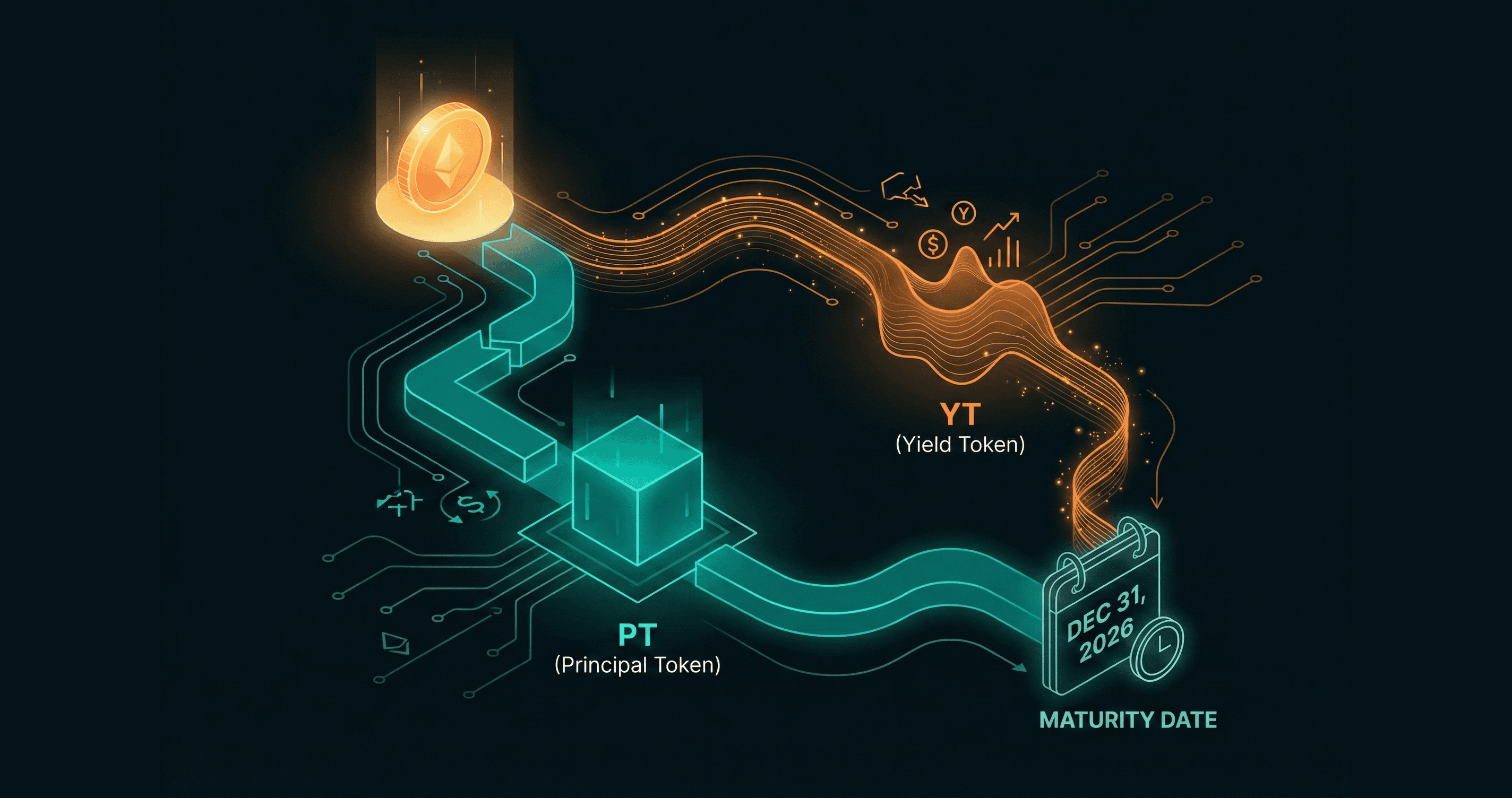
Yield tokenization takes a yield-bearing asset and separates its value into two distinct claims.
Imagine you have 1 stETH earning staking rewards. That single token contains two types of value: the underlying ETH (principal) and the future staking rewards (yield). Normally, these are bundled together. You can't sell one without the other.
Pendle unbundles them. You deposit your stETH and receive two tokens back:
Principal Token (PT) represents your claim to the underlying asset at maturity. If you hold PT-stETH until the maturity date, you can redeem it for 1 ETH worth of value. Between now and maturity, PT trades at a discount reflecting the time value of money.
Yield Token (YT) represents your claim to all yield the asset generates until maturity. If stETH earns 4% APY over the next year, holding YT-stETH entitles you to that entire 4% yield stream.
Here's the crucial invariant: PT value + YT value always equals the original asset value. They're complementary pieces of the same underlying.
How do PT tokens work?
Principal Tokens are the simpler of the two. They give you fixed yield.
Here's the mechanism. If 1 stETH is worth $3,000 and the one-year PT-stETH trades at $2,850, you're effectively locking in a 5.26% yield. At maturity, your PT is redeemable for $3,000 worth of ETH. The $150 discount is your guaranteed return.
This works regardless of what happens to stETH yields during the year. Even if staking rates drop to 2%, your PT still redeems at face value. You've locked in 5.26%.
PT prices increase as maturity approaches. A PT trading at a 5% discount with one year left might trade at a 2.5% discount with six months left. If you need to exit early, you can sell the PT on Pendle's AMM at the current market price.
Who buys PT? Anyone who wants predictable returns. Treasuries, DAOs with runway to manage, or individuals who prefer certainty over potential upside.
How do YT tokens work?
Yield Tokens are where things get interesting. They're essentially leveraged bets on future yields.
When you buy YT, you're paying a fraction of the asset's value to receive all of its yield until maturity. If YT-stETH costs $150 (for an asset worth $3,000), and stETH yields 5% over the year ($150 in yield), you break even. If it yields 6% ($180), you profit. If it yields 3% ($90), you lose.
YT is effectively 20x leverage on yield in this example. You're paying $150 to gain exposure to the yield on $3,000 of underlying. Small changes in yield rates translate to large changes in YT returns.
As maturity approaches, YT value declines toward zero. At maturity, there's no future yield left to claim. The YT is worthless. This time decay is priced into YT trading.
Who buys YT? Traders speculating that yields will increase. If you believe Ethereum staking rewards will rise (maybe due to increased MEV or protocol changes), buying YT is how you express that view.
What are the use cases?
Pendle serves several distinct user types.
Locking in fixed yield
If you're a DAO treasury or institution that needs predictable returns, buying PT gives you fixed income. You know exactly what you'll receive at maturity, regardless of market volatility. This is the closest thing DeFi has to bonds.
Yield speculation
If you believe yields will rise, YT is leveraged exposure to that view. The 70% of Pendle volume that's YT speculation suggests many traders use it this way. It's yield gambling with defined risk.
Hedging existing positions
If you're earning yield on stETH and worried rates might drop, you could sell YT against your position. You receive cash upfront in exchange for giving up future yield. This locks in current rates similar to a swap in traditional finance.
Points and airdrops
Many DeFi protocols distribute points or prepare for airdrops based on participation. YT holders often receive these rewards since they're the "active" side of the position. Some traders buy YT primarily for points exposure rather than yield speculation.
How does Pendle's market structure work?
Understanding Pendle's liquidity dynamics helps you use it effectively.
Multiple maturities per asset
Pendle doesn't have one stETH market. It has 12 separate markets across different maturity dates: March 2026, June 2026, September 2026, December 2026, and so on. Each maturity is its own isolated pool with distinct liquidity.
The top 5 markets hold 80% of TVL. Longer-dated maturities often have thinner liquidity, meaning larger price impact when trading.
Liquidity fragmentation
This multi-maturity structure creates fragmentation. Unlike a traditional AMM where all liquidity is fungible, Pendle liquidity is split across time horizons. Traders need to consider not just price but which maturity best matches their view.
Concentrated activity
About 70% of volume is YT speculation rather than PT hedging. This tells you who's actually using the protocol: traders betting on yield movements rather than institutions seeking fixed income. The product-market fit is leveraged yield gambling more than structured fixed income.
What are the risks?
Pendle introduces risks beyond standard DeFi concerns.
Maturity timing
If you buy PT or YT, you're committing to a specific maturity date. Life circumstances or market conditions might require you to exit early. While you can sell before maturity, liquidity might be thin or prices unfavorable. The longer the maturity, the more uncertainty.
YT time decay
YT loses value continuously as maturity approaches. Even if yields stay constant, YT worth $150 with one year to maturity might be worth $75 with six months left. You need yields to rise enough to overcome this decay.
Smart contract risk
Pendle's contracts are complex. They handle yield tokenization, AMM mechanics, and multi-chain operations. While audited, the protocol has more attack surface than simpler DeFi protocols. Read our guide on staying safe in DeFi.
Liquidity risk
If you need to exit a large position in a less popular maturity, you might face significant slippage. Always check pool depth before trading.
Underlying asset risk
PT and YT derive value from the underlying asset. If stETH depegs from ETH, your PT redemption value is affected. The yield tokenization doesn't eliminate risks in the underlying, just restructures them.
How big is Pendle?
Pendle has become one of the largest DeFi protocols by several metrics.
In 2025, the protocol achieved $40 million in annualized protocol revenue. Average TVL reached $5.8 billion. Trading volume hit $47.8 billion. These numbers put Pendle among the top 10 DeFi protocols by activity.
The protocol peaked above $13 billion TVL in September 2025 before moderating. It controls over 50% market share of the yield-management DeFi segment.
Recent expansion includes launching on Solana via Chainlink CCIP (December 2025) and Unichain (December 2025). The multi-chain strategy brings yield tokenization to users who prefer different ecosystems.
How does this connect to yield strategies?
Understanding Pendle helps you evaluate yield opportunities more generally.
When you see a vault or strategy advertising a particular yield, you can now think about it in PT/YT terms. Is this yield fixed or variable? What's the implicit PT discount? What would YT exposure cost?
Some DeFi strategies incorporate Pendle PT as a yield source. By buying discounted PT, they lock in fixed returns without the variability of lending rates. This is useful for strategies that need predictable performance for marketing or treasury purposes.
Pistachio's Curated Investment Vaults may include Pendle-based strategies where appropriate. Understanding the mechanics helps you evaluate whether a vault's risk-return profile matches your goals. The passive income strategies we evaluate range from simple staking to more complex yield structures.
What it comes down to
Pendle brings fixed income concepts to DeFi. By splitting yield-bearing assets into principal and yield tokens, it opens up options for risk management and speculation that didn't exist before.
PT gives you fixed, predictable returns by buying at a discount and holding to maturity. YT gives you leveraged exposure to yield movements with the potential for outsized gains or losses.
The protocol's $69.8 billion in settled yield demonstrates real adoption. But 70% of that volume is speculation, not hedging. Pendle's actual product-market fit is leveraged yield trading for sophisticated users, not yet mainstream fixed income for conservative treasuries.
If you're comfortable with the complexity, Pendle offers tools that don't exist elsewhere in DeFi. Lock in rates when you think they're attractive. Speculate on yields rising during bullish periods. Hedge exposure when uncertainty increases.
Just understand what you're buying. PT is relatively straightforward. YT is a decaying, leveraged bet that requires yields to outperform your purchase price. Both have places in sophisticated portfolios, but neither is set-and-forget.
Last updated: February 2026
Frequently asked questions
What is a Principal Token (PT)?
PT represents the principal value of a yield-bearing asset at maturity. Buying PT at a discount and holding to maturity gives you fixed yield. For example, buying PT-stETH at 95% of face value and redeeming at 100% gives you 5.26% return.
What is a Yield Token (YT)?
YT represents all yield a asset generates until maturity. It's leveraged exposure to yield rates. If yields rise, YT increases in value. If yields fall or stay low, YT loses value and eventually expires worthless at maturity.
Is Pendle safe?
Pendle has been audited and handles billions in TVL, but carries smart contract risk like any DeFi protocol. Additional risks include maturity timing, YT time decay, and liquidity fragmentation across different maturity markets.
What's Pendle's TVL?
Pendle averaged $5.8 billion TVL in 2025, peaked above $13 billion, and controls over 50% of the yield-management DeFi segment. It processed $47.8 billion in trading volume for the year.
Can I use Pendle on Solana?
Yes, Pendle expanded to Solana via Chainlink CCIP in December 2025. Principal Tokens are now available through Kamino on Solana, marking Pendle's first non-EVM deployment.
Pendle has settled $69.8 billion in yield trades. That makes it the bridge between crypto's $6 billion TVL DeFi market and traditional finance's $140 trillion fixed income world.
The concept is straightforward: take any yield-bearing asset, split it into two pieces, and let people trade them separately. Want guaranteed fixed yield? Buy one piece. Want to speculate that yields will rise? Buy the other. Pistachio.fi is a crypto yield platform that helps you access curated DeFi strategies, including understanding protocols like Pendle.
Key takeaways
Yield tokenization splits assets into Principal Tokens (PT) and Yield Tokens (YT) with a fixed maturity date.
PT gives you fixed yield by buying at a discount and redeeming at face value at maturity.
YT gives you all yield until maturity. If rates rise, YT becomes more valuable. If they fall, you lose.
Pendle's scale: $5.8B average TVL, $47.8B trading volume in 2025, $40M protocol revenue.
What is yield tokenization?
Yield tokenization takes a yield-bearing asset and separates its value into two distinct claims.
Imagine you have 1 stETH earning staking rewards. That single token contains two types of value: the underlying ETH (principal) and the future staking rewards (yield). Normally, these are bundled together. You can't sell one without the other.
Pendle unbundles them. You deposit your stETH and receive two tokens back:
Principal Token (PT) represents your claim to the underlying asset at maturity. If you hold PT-stETH until the maturity date, you can redeem it for 1 ETH worth of value. Between now and maturity, PT trades at a discount reflecting the time value of money.
Yield Token (YT) represents your claim to all yield the asset generates until maturity. If stETH earns 4% APY over the next year, holding YT-stETH entitles you to that entire 4% yield stream.
Here's the crucial invariant: PT value + YT value always equals the original asset value. They're complementary pieces of the same underlying.
How do PT tokens work?
Principal Tokens are the simpler of the two. They give you fixed yield.
Here's the mechanism. If 1 stETH is worth $3,000 and the one-year PT-stETH trades at $2,850, you're effectively locking in a 5.26% yield. At maturity, your PT is redeemable for $3,000 worth of ETH. The $150 discount is your guaranteed return.
This works regardless of what happens to stETH yields during the year. Even if staking rates drop to 2%, your PT still redeems at face value. You've locked in 5.26%.
PT prices increase as maturity approaches. A PT trading at a 5% discount with one year left might trade at a 2.5% discount with six months left. If you need to exit early, you can sell the PT on Pendle's AMM at the current market price.
Who buys PT? Anyone who wants predictable returns. Treasuries, DAOs with runway to manage, or individuals who prefer certainty over potential upside.
How do YT tokens work?
Yield Tokens are where things get interesting. They're essentially leveraged bets on future yields.
When you buy YT, you're paying a fraction of the asset's value to receive all of its yield until maturity. If YT-stETH costs $150 (for an asset worth $3,000), and stETH yields 5% over the year ($150 in yield), you break even. If it yields 6% ($180), you profit. If it yields 3% ($90), you lose.
YT is effectively 20x leverage on yield in this example. You're paying $150 to gain exposure to the yield on $3,000 of underlying. Small changes in yield rates translate to large changes in YT returns.
As maturity approaches, YT value declines toward zero. At maturity, there's no future yield left to claim. The YT is worthless. This time decay is priced into YT trading.
Who buys YT? Traders speculating that yields will increase. If you believe Ethereum staking rewards will rise (maybe due to increased MEV or protocol changes), buying YT is how you express that view.
What are the use cases?
Pendle serves several distinct user types.
Locking in fixed yield
If you're a DAO treasury or institution that needs predictable returns, buying PT gives you fixed income. You know exactly what you'll receive at maturity, regardless of market volatility. This is the closest thing DeFi has to bonds.
Yield speculation
If you believe yields will rise, YT is leveraged exposure to that view. The 70% of Pendle volume that's YT speculation suggests many traders use it this way. It's yield gambling with defined risk.
Hedging existing positions
If you're earning yield on stETH and worried rates might drop, you could sell YT against your position. You receive cash upfront in exchange for giving up future yield. This locks in current rates similar to a swap in traditional finance.
Points and airdrops
Many DeFi protocols distribute points or prepare for airdrops based on participation. YT holders often receive these rewards since they're the "active" side of the position. Some traders buy YT primarily for points exposure rather than yield speculation.
How does Pendle's market structure work?
Understanding Pendle's liquidity dynamics helps you use it effectively.
Multiple maturities per asset
Pendle doesn't have one stETH market. It has 12 separate markets across different maturity dates: March 2026, June 2026, September 2026, December 2026, and so on. Each maturity is its own isolated pool with distinct liquidity.
The top 5 markets hold 80% of TVL. Longer-dated maturities often have thinner liquidity, meaning larger price impact when trading.
Liquidity fragmentation
This multi-maturity structure creates fragmentation. Unlike a traditional AMM where all liquidity is fungible, Pendle liquidity is split across time horizons. Traders need to consider not just price but which maturity best matches their view.
Concentrated activity
About 70% of volume is YT speculation rather than PT hedging. This tells you who's actually using the protocol: traders betting on yield movements rather than institutions seeking fixed income. The product-market fit is leveraged yield gambling more than structured fixed income.
What are the risks?
Pendle introduces risks beyond standard DeFi concerns.
Maturity timing
If you buy PT or YT, you're committing to a specific maturity date. Life circumstances or market conditions might require you to exit early. While you can sell before maturity, liquidity might be thin or prices unfavorable. The longer the maturity, the more uncertainty.
YT time decay
YT loses value continuously as maturity approaches. Even if yields stay constant, YT worth $150 with one year to maturity might be worth $75 with six months left. You need yields to rise enough to overcome this decay.
Smart contract risk
Pendle's contracts are complex. They handle yield tokenization, AMM mechanics, and multi-chain operations. While audited, the protocol has more attack surface than simpler DeFi protocols. Read our guide on staying safe in DeFi.
Liquidity risk
If you need to exit a large position in a less popular maturity, you might face significant slippage. Always check pool depth before trading.
Underlying asset risk
PT and YT derive value from the underlying asset. If stETH depegs from ETH, your PT redemption value is affected. The yield tokenization doesn't eliminate risks in the underlying, just restructures them.
How big is Pendle?
Pendle has become one of the largest DeFi protocols by several metrics.
In 2025, the protocol achieved $40 million in annualized protocol revenue. Average TVL reached $5.8 billion. Trading volume hit $47.8 billion. These numbers put Pendle among the top 10 DeFi protocols by activity.
The protocol peaked above $13 billion TVL in September 2025 before moderating. It controls over 50% market share of the yield-management DeFi segment.
Recent expansion includes launching on Solana via Chainlink CCIP (December 2025) and Unichain (December 2025). The multi-chain strategy brings yield tokenization to users who prefer different ecosystems.
How does this connect to yield strategies?
Understanding Pendle helps you evaluate yield opportunities more generally.
When you see a vault or strategy advertising a particular yield, you can now think about it in PT/YT terms. Is this yield fixed or variable? What's the implicit PT discount? What would YT exposure cost?
Some DeFi strategies incorporate Pendle PT as a yield source. By buying discounted PT, they lock in fixed returns without the variability of lending rates. This is useful for strategies that need predictable performance for marketing or treasury purposes.
Pistachio's Curated Investment Vaults may include Pendle-based strategies where appropriate. Understanding the mechanics helps you evaluate whether a vault's risk-return profile matches your goals. The passive income strategies we evaluate range from simple staking to more complex yield structures.
What it comes down to
Pendle brings fixed income concepts to DeFi. By splitting yield-bearing assets into principal and yield tokens, it opens up options for risk management and speculation that didn't exist before.
PT gives you fixed, predictable returns by buying at a discount and holding to maturity. YT gives you leveraged exposure to yield movements with the potential for outsized gains or losses.
The protocol's $69.8 billion in settled yield demonstrates real adoption. But 70% of that volume is speculation, not hedging. Pendle's actual product-market fit is leveraged yield trading for sophisticated users, not yet mainstream fixed income for conservative treasuries.
If you're comfortable with the complexity, Pendle offers tools that don't exist elsewhere in DeFi. Lock in rates when you think they're attractive. Speculate on yields rising during bullish periods. Hedge exposure when uncertainty increases.
Just understand what you're buying. PT is relatively straightforward. YT is a decaying, leveraged bet that requires yields to outperform your purchase price. Both have places in sophisticated portfolios, but neither is set-and-forget.
Last updated: February 2026
Frequently asked questions
What is a Principal Token (PT)?
PT represents the principal value of a yield-bearing asset at maturity. Buying PT at a discount and holding to maturity gives you fixed yield. For example, buying PT-stETH at 95% of face value and redeeming at 100% gives you 5.26% return.
What is a Yield Token (YT)?
YT represents all yield a asset generates until maturity. It's leveraged exposure to yield rates. If yields rise, YT increases in value. If yields fall or stay low, YT loses value and eventually expires worthless at maturity.
Is Pendle safe?
Pendle has been audited and handles billions in TVL, but carries smart contract risk like any DeFi protocol. Additional risks include maturity timing, YT time decay, and liquidity fragmentation across different maturity markets.
What's Pendle's TVL?
Pendle averaged $5.8 billion TVL in 2025, peaked above $13 billion, and controls over 50% of the yield-management DeFi segment. It processed $47.8 billion in trading volume for the year.
Can I use Pendle on Solana?
Yes, Pendle expanded to Solana via Chainlink CCIP in December 2025. Principal Tokens are now available through Kamino on Solana, marking Pendle's first non-EVM deployment.

Cross-chain crypto swaps: how Li.Fi powers Pistachio's one-tap zaps (2026)

Etherfuse stablebonds: earn government bond yields on-chain (2026)
How to earn money online in 2026 (crypto yield vs. the rest)
Linea crypto explained: what it is and how it works (2026)

Ethereum wallet guide 2026 (ethernet wallet explained)
DeFi Staking with Stader Labs: How ETHx Works in 2026

High-liquidity crypto exchanges: PancakeSwap guide 2026
What is Raydium? How Solana's AMM Works in 2026
Passive Income Ideas for 2026: 10 Ways That Actually Work

Hong Kong crypto news 2026: licenses, stablecoins, and regulation
©2026 Derechos de autor, PistachioFi Inc.
©2026 Derechos de autor, PistachioFi Inc.
©2026 Derechos de autor, PistachioFi Inc.